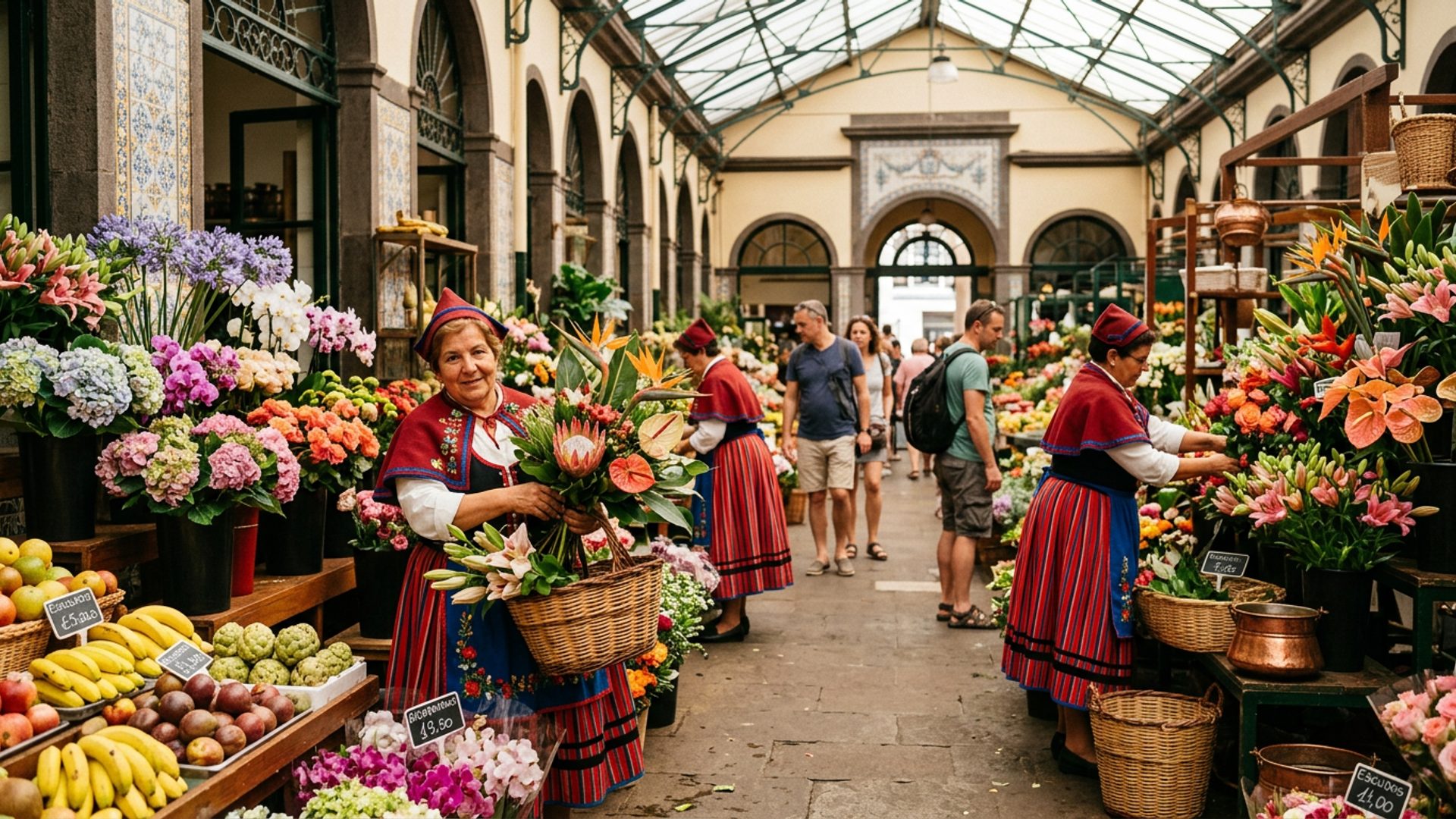
The Madeira Food Guide: 12 Things to Eat and Drink on the Island
Madeira's food culture is older than its tourism industry, and that's the point. The island's kitchen evolved in isolation — cut off from mainland Portugal by a five-day sail for most of its history — and developed a set of ingredients, techniques, and dishes that exist nowhere else. This guide covers the twelve things worth eating and drinking before you leave.
1. Espetada
The most Madeiran thing you can eat. Cubes of beef, rubbed with sea salt and bay leaf, skewered on a rod of laurel wood, and cooked over open coals until the outside chars and the inside stays just-done. It's served hanging — the skewer suspended on a hook over the table so the fat keeps dripping, not pooling. Traditionally eaten at a hillside adega (wine house) in the north of the island, not in Funchal.
What makes it taste different is the laurel. The wood infuses the meat as it cooks; no gas grill or metal skewer can replicate it. The accompanying bread — bolo do caco — is non-negotiable.
Where to find it: The authentic version is in villages on the north coast, especially around Santana and Faial. Ask locals, not TripAdvisor.
2. Bolo do Caco
A flatbread baked on a hot basalt stone (the caco). The dough is made from sweet potato, which gives it a slight sweetness and a texture somewhere between an English muffin and a chapati. Split and spread with garlic butter, it's the bread that appears at every adega table alongside espetada.
It's also sold fresh at markets and bakeries across the island — best eaten warm, split open, while the garlic butter is still melting. At Mercado dos Lavradores, the stalls near the entrance serve it as a grab-and-go breakfast.
What to order: Bolo do caco com manteiga de alho (with garlic butter).
3. Poncha
A drink made from aguardente de cana — sugar-cane spirit distilled on the island — mixed with honey and lemon juice, stirred with a wooden stick called a caralhinho. The original version is known as poncha da Ribeira Brava; variations include orange poncha and passion fruit. Alcohol content is typically around 20–25%.
Poncha is not decorative. It's drunk at the end of a long meal, or at the start of a night out, or both. The version served at tourist restaurants tends to be sweeter and weaker than what you'll get at a village bar in the north. The cane spirit used in the best poncha is distilled locally, often at the same quinta that makes the wine.
Important: Do not confuse poncha made with locally distilled aguardente with the bottled version from supermarkets. They are not the same drink.
4. Black Scabbardfish (Espada)
One of the stranger things about eating in Funchal is the fish. The espada — black scabbardfish — is caught at depths of 800–1000 metres in overnight fishing runs from Câmara de Lobos and brought to the Mercado dos Lavradores by dawn. By midday it's on menus across the city.
It's a deep-sea eel-like fish, silvery-black, with enormous eyes adapted for near-total darkness. On the plate it's white, delicate, and sweet — usually served com banana (with banana, fried or grilled), a combination that sounds odd and tastes exactly right. At the market, you can buy it whole from the fishmonger who caught it the previous night.
Where to order it: Any traditional restaurant in Funchal's Zona Velha. Ask for espada com banana and resist the urge to order the sea bass.
5. Madeira Wine
The wine is not from the island in the way that Burgundy is from Burgundy — it's made here, but it was the global trade routes that defined its style. Madeira wine is deliberately oxidised and heat-treated (a process called estufagem), which makes it the most stable wine in the world. Bottles from the 18th century are still drinkable; some are still remarkable.
There are four main grape styles: Sercial (dry, nutty, high acidity), Verdelho (medium-dry, smoky), Bual (medium-rich, raisin notes), and Malmsey (sweet, full-bodied). Most bottles you see in shops are blended and labelled by style. The real thing — a 20-year Verdelho from a family quinta in Câmara de Lobos — is something else entirely.
How to taste it properly: Skip the shops. Visit a quinta during harvest (August–September) or book a proper tasting at a working winery. The family-run estates in Câmara de Lobos offer access that the big lodges in Funchal don't.
6. Queijo da Ilha (Island Cheese)
A semi-hard yellow cheese made from cow's milk, originally from São Jorge in the Azores but produced on Madeira for centuries. It has a sharp, slightly salty flavour and a waxy rind. Younger versions are milder; aged queijo da ilha develops a crystalline, almost parmesan-like texture.
It's eaten as a starter with bolo do caco, as part of a cheese board alongside queijo fresco (fresh curd cheese), or in the market as a wedge cut to order. At wine tastings, it's served with house-cured charcuterie as a counter to the wine's acidity.
What to look for: Queijo da Ilha aged for at least six months. Ask the vendor — market stalls will tell you when it was made.
7. Lapas (Grilled Limpets)
The island's default seaside snack: limpets, grilled on a hot iron plate with garlic butter and a squeeze of lemon. They're served shell-up, still in the iron, with bread to mop the butter. There's almost no wrong time to eat lapas — they appear as a starter at lunch, as a bar snack, and at beach restaurants.
The limpets come from the rocky coastline between Câmara de Lobos and the west of the island; they're gathered by hand at low tide. The ones on the north coast tend to be slightly larger and saltier.
Where to eat them: Any adega on the coast. Avoid any restaurant where lapas are listed at more than €8 for a portion — you're being sold to, not fed.
8. Carne de Vinha d'Alhos
The dish that became Cuban ropa vieja and American picadillo — Madeiran pork marinated in wine, garlic, and bay leaf, then slow-cooked. This is the original vindaloo, exported from here to Goa by Portuguese traders in the 16th century and then brought back to Europe in a form that no longer resembles the original.
The Madeiran version is still made for Christmas and eaten on New Year's Eve. You'll find it at traditional restaurants year-round, usually as a pork shoulder or ribs, deeply flavoured from two or three days in the marinade.
9. Caldo Verde
A reminder that Madeira is Portuguese. Caldo verde — kale soup with chouriço and potatoes — is the everyday soup eaten on the island, particularly in winter. The version here tends to be thicker and more potato-heavy than the mainland style. It appears as a starter at traditional restaurants and as a weekday lunch at market cafés.
It's not a tourist dish. It's a family dish, the thing cooked when someone is ill or cold, and it tastes like it.
10. Mel de Cana (Cane Molasses)
Not honey, despite the name — mel de cana is thick cane molasses, a byproduct of sugar production that was Madeira's main export to Europe before wine took over. Dark, viscous, deeply sweet with bitter edges, it's used in the island's most traditional baking: bolo de mel, broas, and the Christmas honey cake.
At markets, mel de cana is sold in old glass jars. It keeps indefinitely, travels well, and costs almost nothing. It's the best edible souvenir from the island.
11. Bolo de Mel (Honey Cake)
Made with mel de cana (not honey), spices, nuts, and dried fruit, bolo de mel is the island's Christmas cake and its oldest baked good. The same recipe has been in continuous production since at least the 16th century. Traditional versions are made once a year, in November, and eaten over the following months.
Good bolo de mel is dense, spiced with cinnamon, cloves, and anise, and cut in thin slices. It tastes nothing like British Christmas cake and everything like something medieval. The best version is from small family producers in the island's interior.
12. Passion Fruit (Maracujá)
The island's most photogenic produce and its most distinctive fruit. Madeira's maracujá are small, intensely perfumed, and sharper than the mass-produced varieties found in European supermarkets. They grow in the highlands, where the altitude and humidity produce a concentration of flavour you can't manufacture.
At Mercado dos Lavradores, the flower women also sell passion fruit — the correct form of purchase is a small bag to eat on the spot, split open with a knife from the stall. In restaurants, passion fruit appears in poncha, in desserts, and as a foam on fish dishes.
Planning a food-focused trip to Madeira?
The three experiences worth booking in advance:
Funchal Old Town & Market Morning — three hours at Mercado dos Lavradores with a guide who knows every stall, then a cable car to Monte and espetada at a local restaurant. The best way to start any visit.
Santana & North Coast Discovery — espetada the way it should be eaten, at a hillside adega in the north, with locally distilled poncha and bolo do caco. Six hours into the part of the island most tourists don't reach.
Madeira Wine & Harvest Experience — private access to a family quinta in Câmara de Lobos, five-vintage tasting with a proper food pairing, and the option to stay for supper. The most food-forward afternoon we offer.
Small groups, max 8 people, led by Ana-Maria Efta.